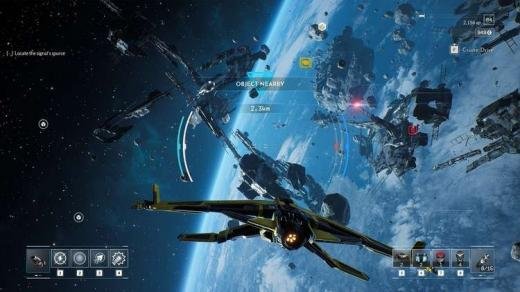
Perfectly pitched VR game 'Star Wars: Squadrons

Star Wars: Squadrons feels like a masterclass in checking. At the point when I state that, I don't mean the focusing on framework found on a Tusken Raider's rifle. Rather, I'm alluding to the game's size, spending plan and boundless VR uphold. In contrast to Star Wars: Battlefront II and Star Wars Jedi: Fallen Order, it is anything but a 'the maximum' $60 title. Rather, it's been shrewdly pitched at $40, strengthening the thought that it's a little game with one basic target: to convey the most exciting and true Star Wars space fights to date.
The title is completely playable in VR yet you needn't bother with a headset to appreciate it. That is an uncommon move in the computer game industry. Most engineers take one of two courses: they either make something that is planned fundamentally for TVs and screens, however has an optional VR mode like the first Battlefront's X-wing mission. Or then again they make something like Vader Immortal, a game that was planned explicitly in view of VR's one of a kind highlights and impediments. The last classification as a rule has a lower spending plan on the grounds that the VR introduces base is such a great amount of littler than conventional consoles and PCs. The special case, obviously, is the point at which a monstrous organization like Oculus supports the whole game.
Groups, be that as it may, don't fall into both of these cans. Rather, it sits in a similar one involved by Resident Evil VII and, apparently, a sprinkling of littler titles like Tetris Effect and Superhot. These are games that can be suggested whether or not the end-client claims a VR headset. You may lean toward one playstyle (I know a lot of individuals who trust PSVR is the most ideal approach to encounter Resident Evil VII) however neither one of the versions is innately sub-par. It's a troublesome difficult exercise that basically isn't workable for some game ideas and sorts. You were unable to make a VR variant of FIFA 21, for example, without changing a portion of its on-the-pitch essentials.
A game like Squadrons has that potential, however. Taking into account both playstyles has drastically expanded the game's span. That, thusly, has permitted EA to be more forceful on the cost — which could expand the player base significantly further — and raise its creation esteems. And keeping in mind that the eight-hour crusade isn't the longest, it's entirely good by VR norms. Joined with the multiplayer suite, it's an alluring suggestion for any Star Wars fan, paying little mind to how you like to play.
To pull this off, however, engineer Motive Studios needed to make an incline toward an unmistakable kind of game.
In contrast to Battlefront II, for example, there's no choice to move the camera behind the boat. You're constantly stuck inside the cockpit, peering out through virtual sheets of calculated glass. Prior to getting the game, I was stressed over this plan choice. I've fiddled with the first-individual point of view in quite a while like Gran Turismo Sport and Wipeout Omega Collection, yet consistently switch back to an outside camera edge since I don't care for having my vision darkened when I'm attempting to set a quick lap time.
I expected that Squadrons would feel comparatively prohibitive and restrict my capacity to perceive what's going on around me. Furthermore, those apprehensions were legitimized, to a degree. A portion of the screen is constantly taken up by anecdotal PCs, making it harder to monitor quick-moving foes. Yet, I wouldn't fret the viewpoint this time. Indeed, I savored it. That is incompletely in light of the fact that my enthusiasm for starship insides immeasurably surpasses hypercar lodges. I've generally longed for sitting inside an X-wing and its different controls have been scratched in my cerebrum since I previously viewed A New Hope. Seeing them all on screen, signaling and glimmering, is fulfilling all alone.

That youngster like satisfaction rises above stages. In case you're wearing a VR headset, it's wonderfully enjoyable to gaze at your legs — which are canvassed in orange or dark overalls, contingent upon the side you're battling for — or rapidly look left and see what's hurrying past your window. Yet, the experience is similarly as convincing on a TV or PC screen. Each time you venture into another boat, you'll need to go through a decent five minutes simply appreciating the detail that is gone into the seat, windows, switches, and readouts.
The instrumentation isn't only to look good, either — it's the game's essential HUD. A few instruments clarify how the boat's capacity is being conveyed. Others speak to the choke and how much lift you have left. Also, there is consistently a couple of that show the boat's auxiliary respectability and, in case you're sufficiently fortunate to have them, the quality and arrangement of its shields. Every inside additionally has a virtual screen that affirms what partner, foe, or guard framework you're presently following in space.
Subsequently, these controls never feel like irritation or something you should intellectually shut out. Rather, they're intended to be looked at. Furthermore, during your initial not many missions, you'll be taking a gander at them a ton, paying little mind to how you're playing.
The instrumentation isn't only to look good.
Pushing a boat around in space is sufficiently straightforward: If you're utilizing a regulator, the left stick modifies your accelerate (and down) and rolls the boat (left and right) evenly, while the correct stick alters your overall course. In any case, each boat has a 'half-choke,' which is featured with a bigger fragment in the increasing speed readout, that lets you turn somewhat righter. In the warmth of fight, you'll likewise need to change between development, assault, and safeguard improved forces profiles, which are set off with a catch press and imagined with blue, red, and green bars on the dashboard.

The rationale might have made an elective HUD that worked with an outside camera edge. Be that as it may, it didn't. Rather, the organization zeroed in on a type of representation that feels instinctive whether you're gazing at a TV or the internal parts of an Oculus Rift.
There's a ton to monitor inside the cockpit. Fortunately, most story missions start with a moderate 'follow the pioneer' area that lets you explore different avenues regarding the essential controls. Before sufficiently long, however, you'll be taking shots at adversaries with a blend of gun discharge and uncommon weaponry that, in case you're utilizing a regulator, are planned to the guards. The game will at that point present assault invalidating countermeasures and progressed methods, for example, help filled floating and custom boat load-outs.
Groups' battle is unhinged and reliably fun, with a decent assortment of boat types that require somewhat various procedures to bring down. In case you're facing a ton of New Republic cruisers, you'll likely need a TIE Bomber since it has a lot of shield and weapon alternatives, for example, a Sienar Team Cannon, that can penetrate heavier guards. Dogfights can infrequently revert into disappointing carousels — the sort where you're wandering aimlessly as quick as could reasonably be expected, however, your adversary is doing likewise and nobody can really arrange a shot — yet generally, it's simple enough to find and vanquish your enemies.
The missions are integrated by a story that is introduced in a VR-accommodating way. You epitomize two pilots that battle for the courageous Vanguard and evil Titan units separately. The preface happens during the first Star Wars set of three however the remainder of the mission is set between Return of the Jedi and The Force Awakens. Much the same as the story from Battlefront II, it investigates the New Republic that is gradually developing in certainty and a debilitated Empire attempting to skip back after the loss of its chief, Emperor Palpatine.

There are 14 missions incomplete that flip-flop between the Titan and Vanguard crew's viewpoint. Prior to every mission, you're permitted to investigate your group's shelter, converse with friends lastly get a multidimensional image helped preparation from your administrator. You can't move around like a conventional first-individual game, however. Rather, you need to move an on-screen cursor and bounce between assigned focuses in the 3D climate. While simple, the framework functions admirably in VR. I likewise valued that you can 'investigate' your current starfighter from numerous edges and, on the off chance that you like, sit inside the cockpit with no adversaries, space rocks, or satellites to stress over.
Exploring these conditions feels abnormally crude on a TV or screen, however. Also, that is a disgrace, since it's the main time when the game sides with a specific playstyle. Was the issue avoidable? Potentially, if the engineers had the opportunity and assets to tissue out the shed areas and execute a customary development framework for non-VR players. However, that is a ton of work for a moderately little aspect of the Squadron's experience. A significant piece of checking is center, and in this circumstance Motive likely settled on the correct decision. The game is fundamentally a dogfighting test system, all things considered, instead of an account experience like Tacoma.
That center reaches out to how the story is conveyed. Toward the beginning of the game, you get the opportunity to pick what every one of your pilots is called, just as their sexual orientation, face, and voice entertainer. It's a slick thought with some undeniable compromises. You're never alluded to by name — just Titan Three and Vanguard Five — and just talk every so often during missions. At that point, back at the shed, both of your characters are frightfully quiet, like other notable gaming saints, for example, Gordon Freeman, Doomguy, and BioShock's Jack. Friends will laud your battle capacity and notice where you were positioned between the introduction and mission one. Yet, you're never given a character like Iden Versio was in the Battlefront II crusade. It's on you, accordingly, to fill in the spaces.
The game's supporting cast is spectacular.
Fortunately, the game's supporting cast is spectacular. Vanguard Squadron has characters like Keo, an ex-racer that is gently power touchy, and Grace, the insubordinate offspring of a family that fabricates TIE warriors. Titan Squadron, then, has Shen, a fight scarred pilot held together by computer science, and Gray, a previous cop that is prepared to resign. Visiting with these characters is altogether discretionary. Yet, on the off chance that you skip them, you'll be passing up some normally intriguing backstories and points of view. I especially preferred Sol's discussions, which investigate the requirement for another Imperial Senate following Emperor Palpatine's end.

I played through a portion of Squadrons' mission in PSVR, and the other half on my parlor TV. I'm conflicted between the two encounters, and that is something to be thankful for. VR is a superior portrayal of what it might really be want to really sit inside a TIE warrior. The separation between the screen and your eyeballs likewise makes a superior showing of duplicating fringe vision in battle. The compromise is visual constancy, however. The involvement with PSVR was observably murkier than my family room TV. At the point when I needed to genuinely appreciate a cloud or the resentment clearing over administrator Kerrill's face, I took the headset off and played the conventional path for some time.
The ideal arrangement, obviously, is a PC-fueled headset and viable flight stick. However, a great many people don't approach such equipment. Also, fortunately, it doesn't make a difference. Overhang route aside, the game is still completely pleasant whether you're playing before a TV or screen. Thought process accomplished this by adhering to a littler, the less difficult idea that spins around a fixed first-individual viewpoint. It doesn't have the rambling aspiration of Battlefront II, however, that really assists with limiting highlights that would cause one playstyle to feel like a reconsideration.
Groups are additional evidence that Resident Evil VII wasn't an accident. With the correct idea and plan choices, it's conceivable to assemble a game that takes into account the VR and TV swarms similarly. It's a model that is difficult to duplicate, honestly, and inappropriate to some game types, similar to third-individual spread shooters. However, it's one that studios ought to take some time to consider before leaving on their next VR venture. In the event that you can fabricate a game that goes past the VR player base, you can hypothetically spend more, and make more, without depending on a limitless ticket to ride from Oculus or Sony.